Deploy fast and know what each one costs in money and efficiency
Everyone ships faster with AI. Nobody checks the cost.
Kubmin does.
Per-workload cost and efficiency tracking across deployments. The missing layer between your workloads and your bill.
You're spending thousands on Kubernetes. But do you know what each workload actually costs?
No Per-Container Visibility
AWS Cost Explorer shows you EC2 bills. Kubecost estimates pod costs. Neither tells you what a single container actually consumes in energy and compute — the real drivers of your bill.
Overprovisioned and Flying Blind
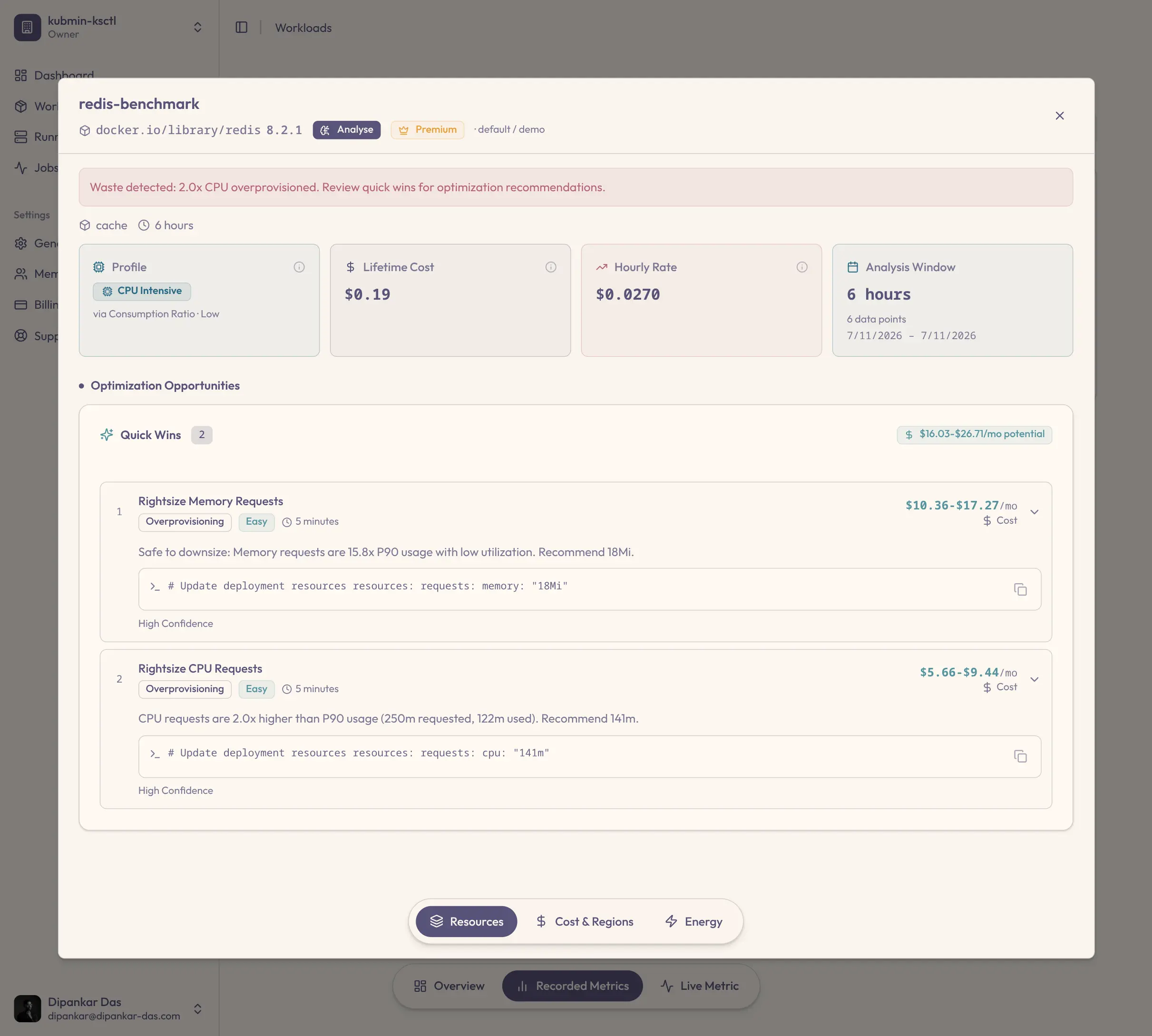
Most teams request 2-4x the resources their workloads actually use. Without per-workload waste detection, you're paying for idle CPU and memory every hour of every day.
Deploys Make It Worse (Silently)
You ship a new image version — maybe AI-generated, maybe hand-written. CPU goes up 15%. Memory creeps up. Nobody notices because no tool tracks efficiency changes between deployments. The waste compounds with every release.
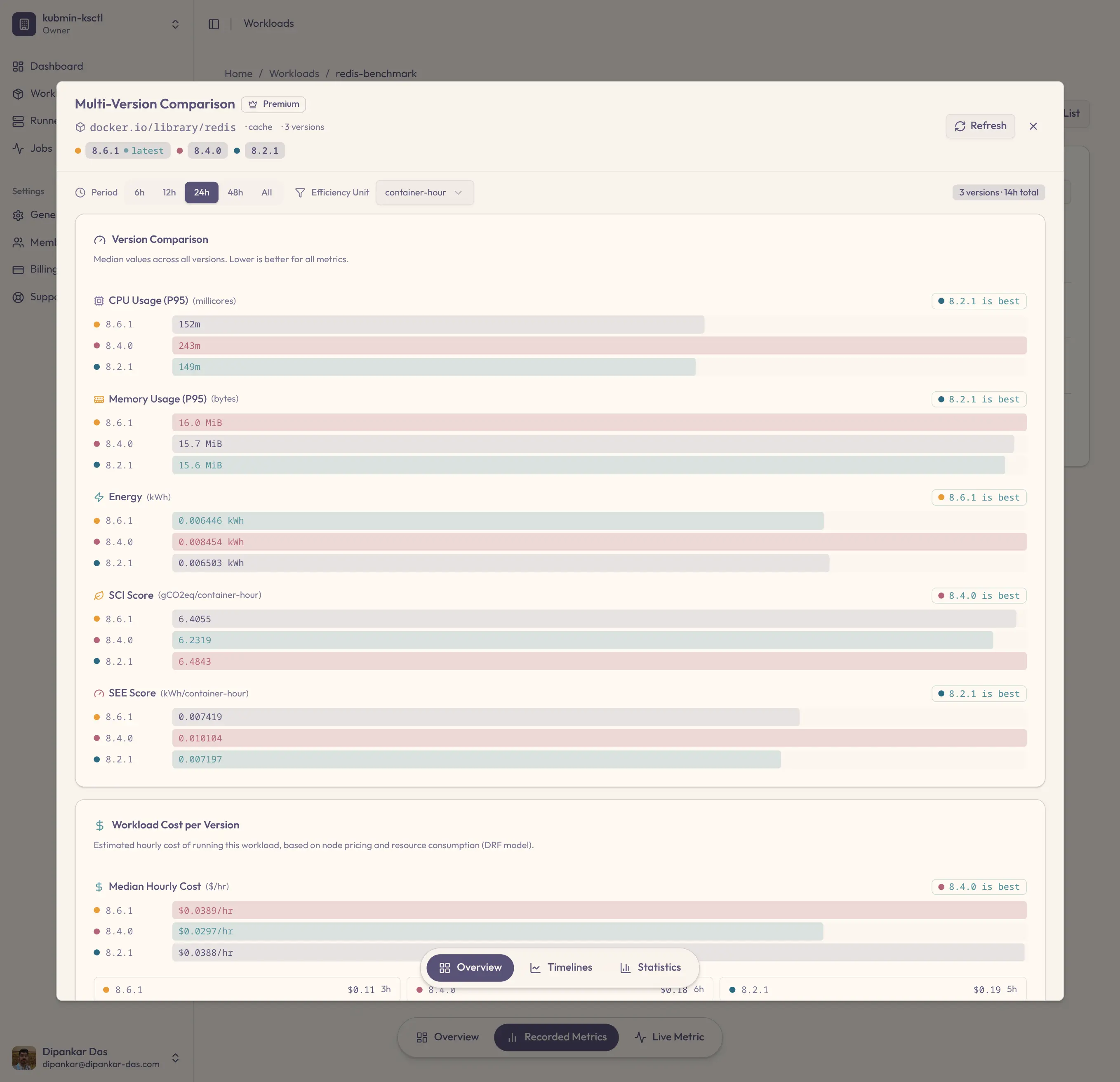
Three Redis versions. Same workload. Wildly different efficiency.
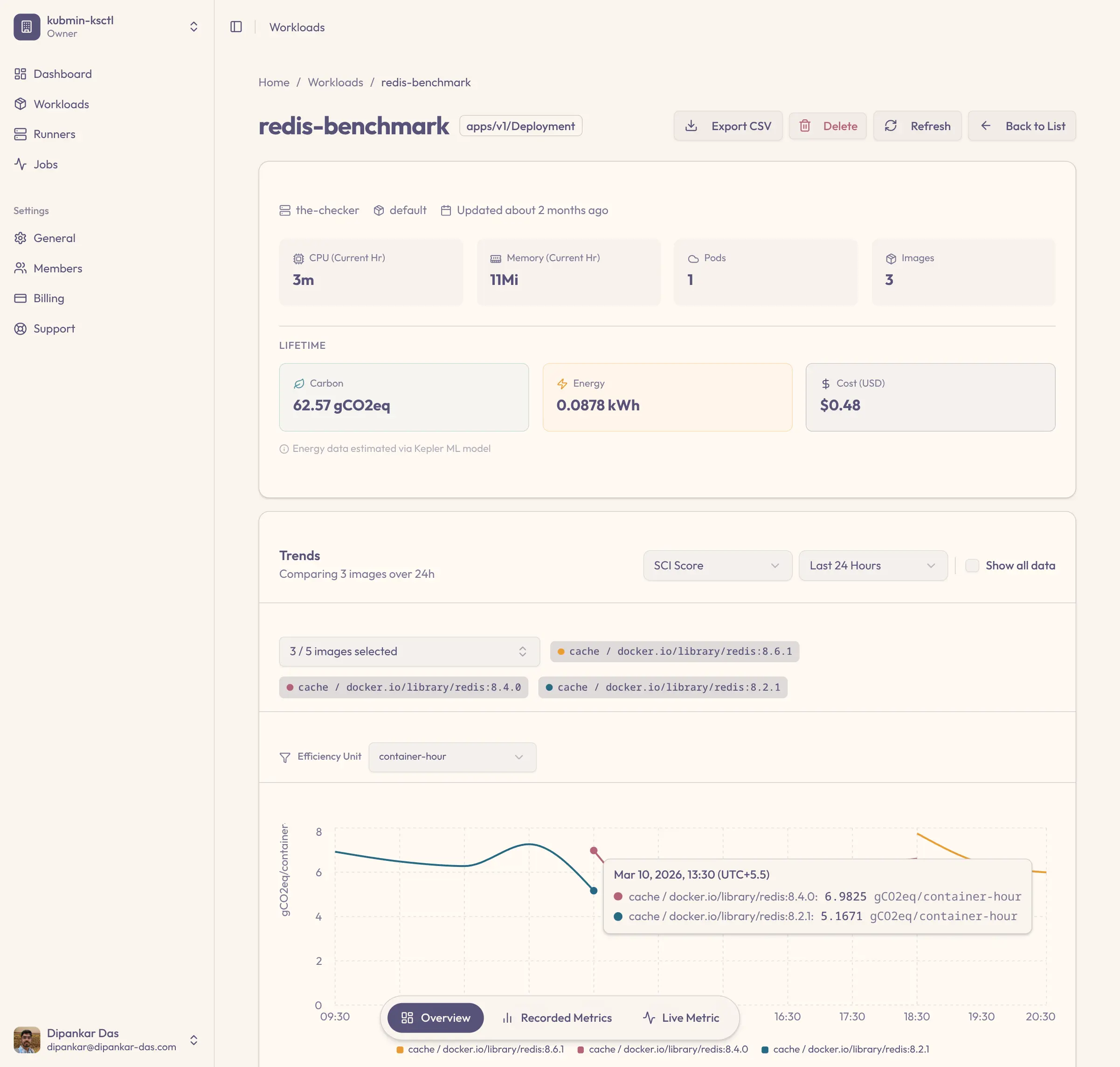
We ran redis-benchmark across versions 8.6.1, 8.4.0, and 8.2.1. Here's what kubmin found — no other tool surfaces this.
8.4.0 uses 87.8% CPU but isn't the most expensive. 8.2.1 uses 51.2% CPU but costs more. No single metric tells the full story — you need cost, energy, and efficiency together. That's what kubmin gives you.
This is one workload. Imagine what kubmin finds across your entire cluster.
Try It On Your WorkloadsFour things no other Kubernetes tool does together
Find Idle & Overprovisioned Workloads
Kubmin detects three types of waste: idle workloads burning resources 24/7, overprovisioned containers using a fraction of their requests, and temporal patterns where waste spikes during off-hours. Each detection comes with dollar amounts attached.
kubectl Commands That Save Money
Every waste detection comes with a ready-to-use kubectl command. Scale down idle replicas, right-size resource requests, remove unused deployments — copy, paste, save. No guesswork.
Compare Any Two Image Versions
Shipped a new release? Compare it against the previous version across cost, energy, CPU, memory, and SCI score. See exactly how your code change affected efficiency — before it hits your bill.
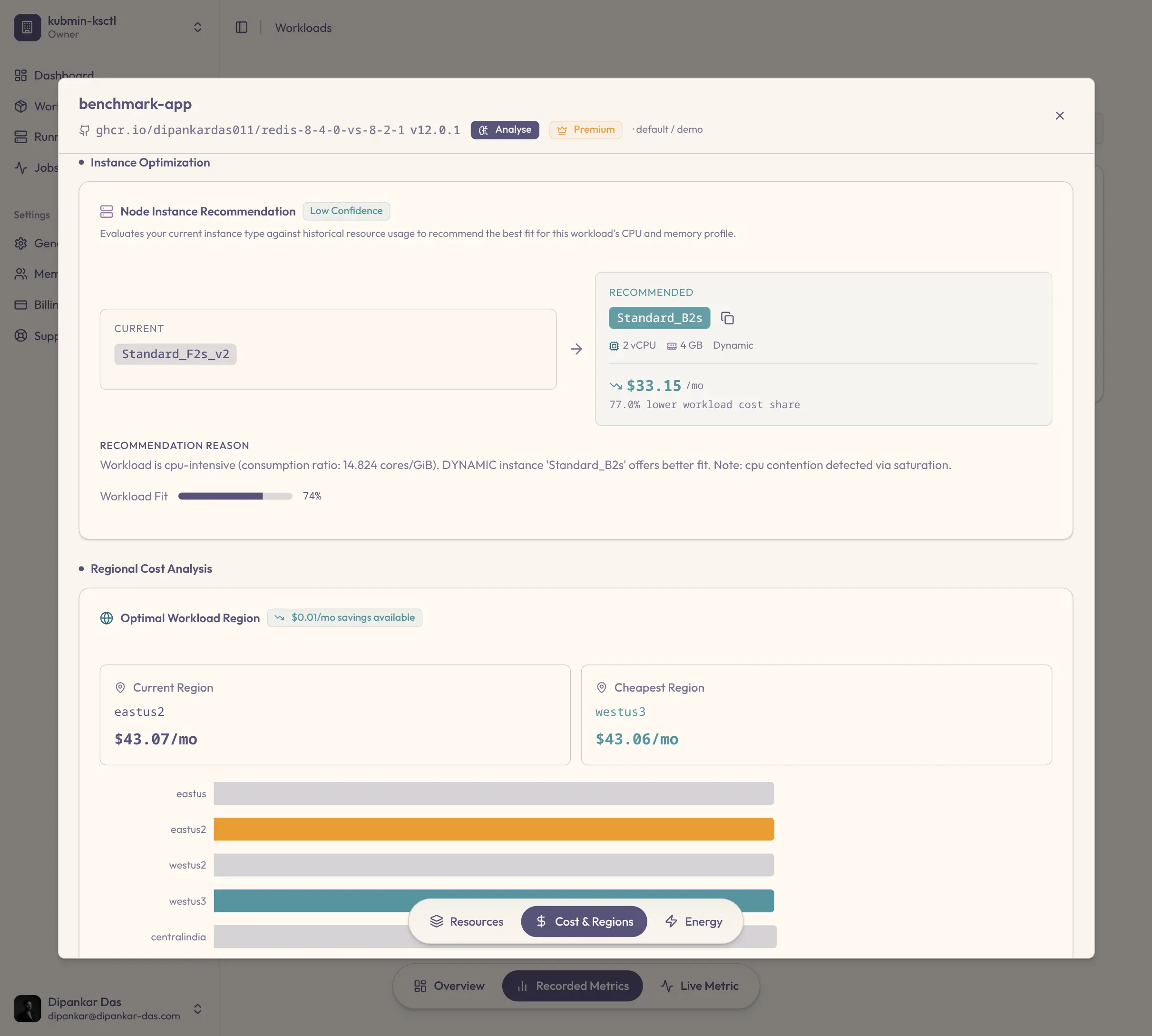
Same Workload, Different Regions, Different Prices
Running in us-east-1 by default? Kubmin compares your workload's cost and carbon footprint across every available region. See exactly how much you'd save by moving — with the sustainability trade-offs laid out side by side.
CPU metrics lie.
Energy doesn't.
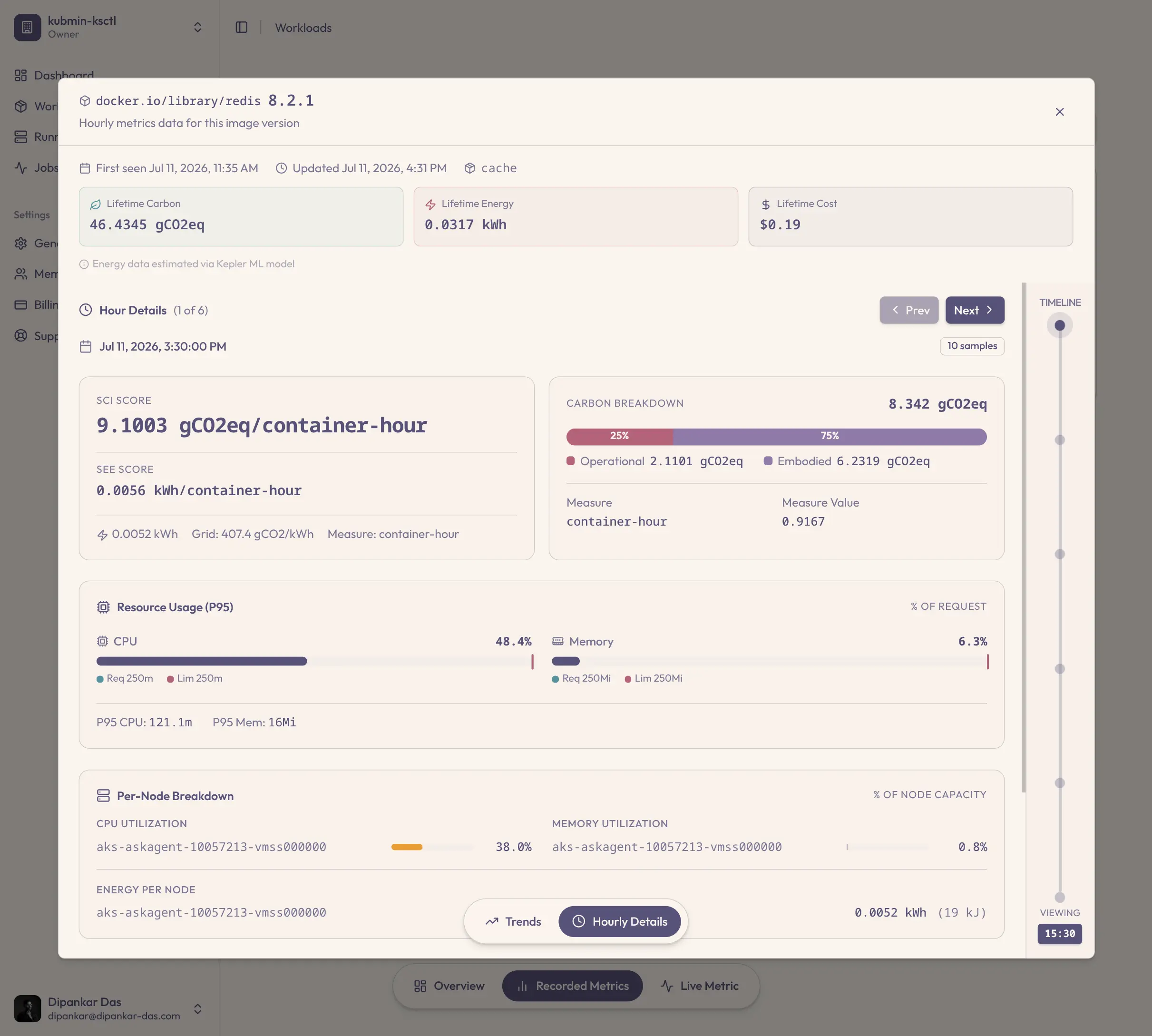
A workload can show 40% CPU utilization and still be wasting energy. How? Polling loops, idle connections, inefficient memory access patterns — they all consume power without producing value. Traditional monitoring tools see 40% busy and move on. Kubmin sees the full picture — CPU usage alongside actual energy consumption over time — so you can spot the workloads where high utilization doesn't mean productive utilization.
Kubmin uses Kepler — a CNCF project — to estimate energy consumption at the container level. Kepler uses kernel-level instrumentation and ML-based models to attribute power usage per container, even in cloud environments where hardware counters aren't directly accessible.
In cloud environments, energy measurements are estimates based on ML models trained on real hardware data. They're highly reliable for relative comparison and trend analysis — which is exactly what kubmin needs. The patterns matter more than the absolute numbers.
This energy data feeds into two key metrics:
tracks the carbon cost of your workloads, aligned with the Green Software Foundation specification.
catches pure efficiency regressions that carbon intensity alone can mask.
Combined with energy trend graphs over time, you get both the financial picture and the sustainability picture in one dashboard.
Three steps to see what you're wasting
Sign Up & Create a Cluster
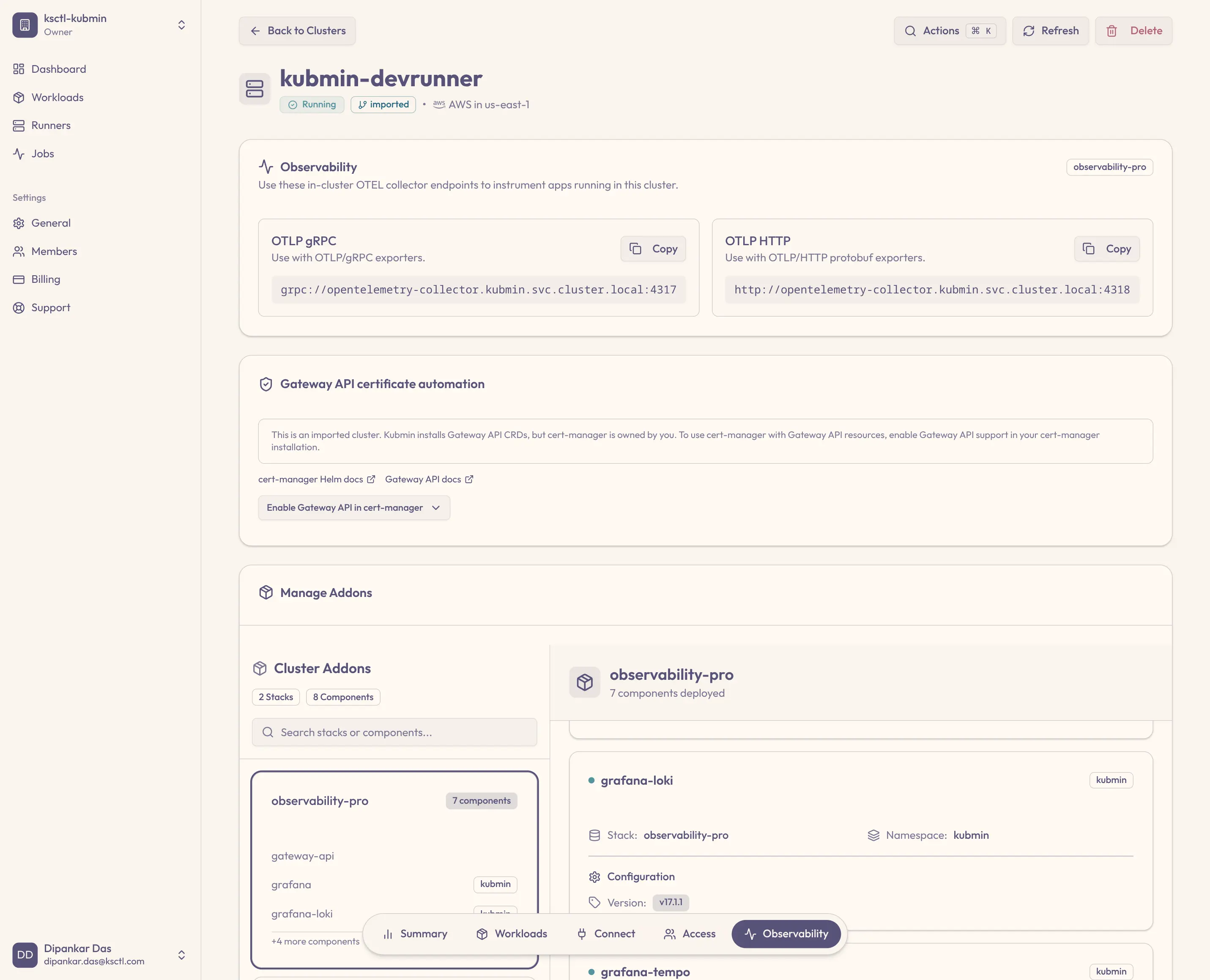
Sign up at kubmin.ksctl.com and create your Kubernetes cluster from the dashboard. Kubmin provisions the full monitoring stack automatically — Prometheus, Kepler, and the kubmin agent. You don't install anything manually.
Label Your Workloads
Add one label and one annotation to the Deployments, StatefulSets, or DaemonSets you want to monitor. The dashboard shows you exactly what to add. That's the only configuration you do.
See Your Results
Kubmin aggregates data hourly and surfaces waste analysis, efficiency grades, cost breakdowns, and Quick Wins automatically. Open the dashboard and start saving.
Currently, clusters are created via ksctl. Support for importing existing clusters is coming soon.
What your current tools
can't tell you
| AWS Cost Explorer | Kubecost | Prometheus + Grafana | kubmin | |
|---|---|---|---|---|
| Per-container cost tracking | EC2 only | Est. | Manual | |
| Energy consumption per workload | ||||
| Idle workload detection | Basic | Manual | Auto | |
| Deployment version comparison | ||||
| SCI + SEE sustainability scoring | ||||
| Regional cost comparison | Partial | |||
| Ready-to-use kubectl fixes | ||||
| Instance type optimization | ||||
| Setup time | N/A | ~30 min | Hours/Days | ~10 min |
Start free. Scale when you need to.
Fixed monthly pricing. No per-node fees. No surprise bills. All plans include auto-deployed Prometheus, Kepler, and Grafana.
Explore
- 1 cluster
- 1 workload
- 1 team member
- SCI tracking (2-day retention)
- Basic workload overview
- Community support
Affordable
- 5 clusters
- 5 workloads
- 10 team members
- Full waste analysis + SCI tracking
- Instance optimization
- Regional cost comparison
- Deployment comparison
- Quick Wins with kubectl commands
- Priority support
Premium
- 20 clusters
- 20 workloads
- 50 team members
- Everything in Affordable
- Dedicated support
Every hour you wait, your clusters
keep wasting.
Sign up free. Connect a cluster. See your waste in minutes.